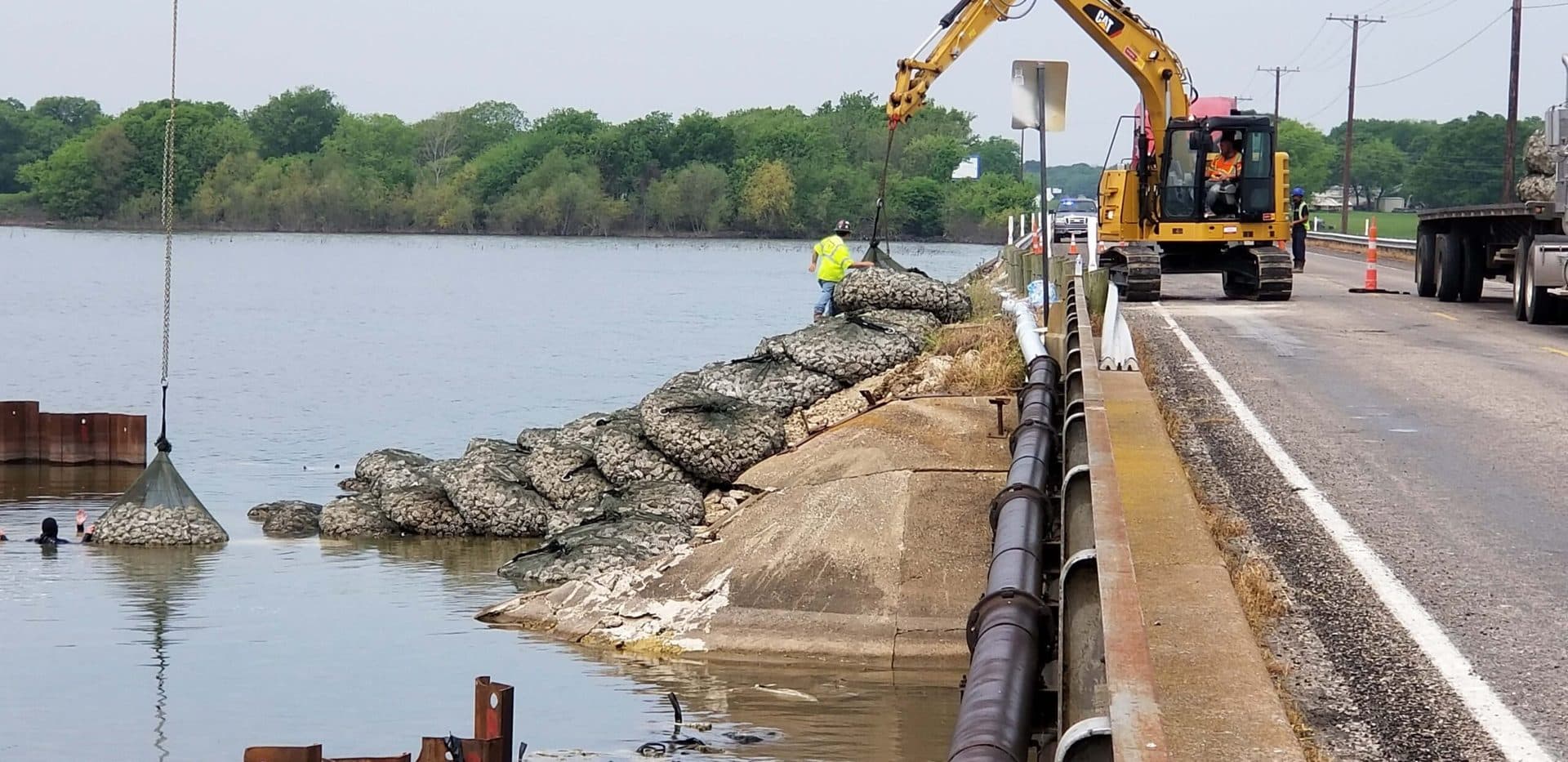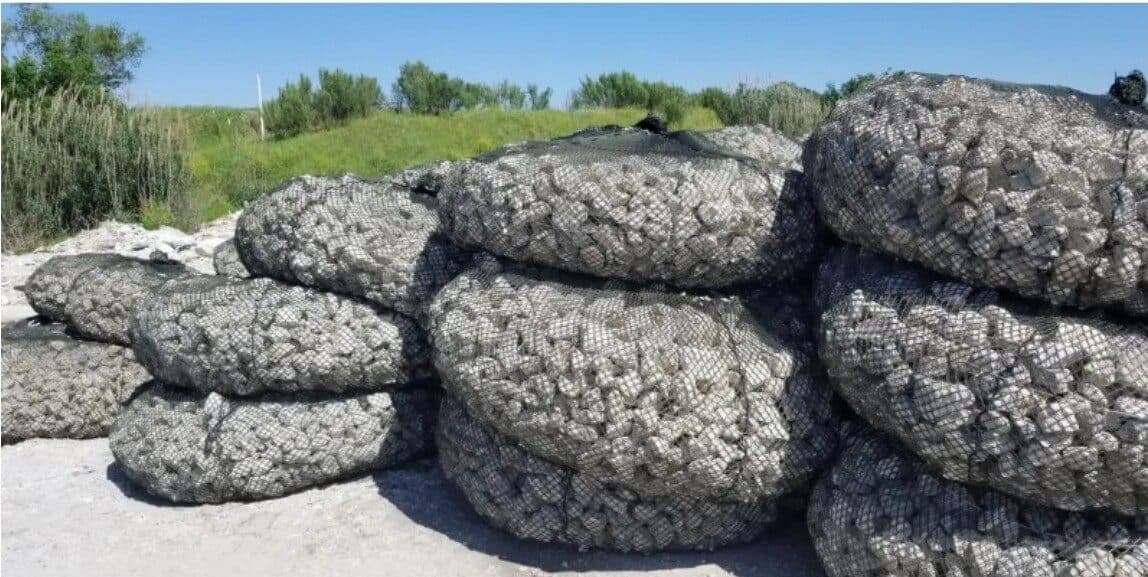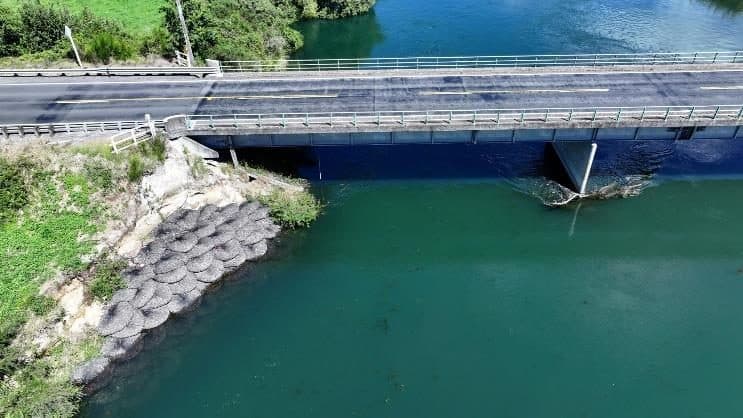
A rock bag is a flexible net filled with graded rock or crushed concrete and lifted by a single ring. Set on a bank, on a river or sea bed, or around a structure, it acts as one heavy, flexible unit that stops flowing water from carrying away the ground beneath it.
Rock bags are used for erosion control, scour protection and soil stabilization: on riverbanks and coasts, at bridges, ports and outfalls, offshore, and in emergency repairs.
The parts of a rock bag
- The net. A flexible mesh that holds the fill. Its openings are smaller than the smallest stones, so the rock stays inside: 25 mm mesh with 50 to 200 mm rock in the 2 and 4 ton bags, 50 mm mesh with 75 to 200 mm rock in the 8 ton bag.
- The fill. Graded rock or crushed concrete. The stones can be smaller than loose armour stone would need to be, because the net makes them act together.
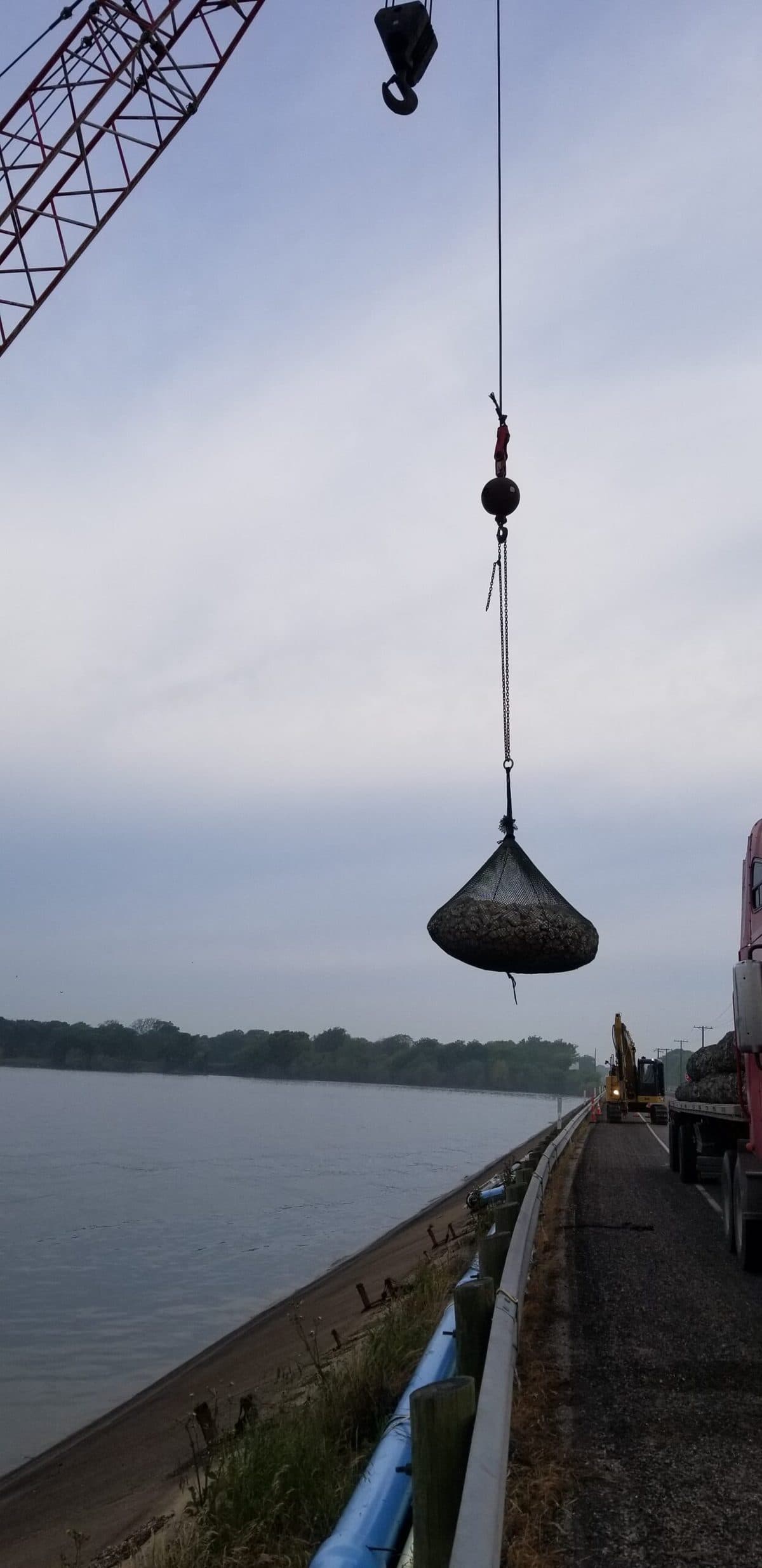
- The lifting ring. The single point of contact during installation: the filled bag is handled and lifted by its ring.
How a rock bag holds back flowing water
Loose stones resist the flow one at a time, so each stone has to be heavy enough on its own. In a rock bag, the net makes the stones work together as one unit of 2, 4 or 8 tons nominal.
Water passes into the gaps between the stones and loses energy there, instead of scouring the bed. Because the net is flexible, the bag settles into hollows and scour holes and stays in contact with the ground as the bed moves.
Bags placed touching each other interlock and resist faster currents than a bag on its own. Over time, the gaps collect silt and fine gravel, and above the water line plants can take root.
Where rock bags are used
Sizes
The last two columns are current ratings: the flow velocity at which the bags show no movement, placed on their own and placed as a group. They are for currents, not waves. Full figures, including imperial units, are in the size guide and on the rock bags page.
| Size | Height (m) | Diameter (m) | Volume (m³) | Single (m/s) | Grouped (m/s) |
|---|---|---|---|---|---|
| 2 ton | 0.4 | 1.9 | 1.13 | 3.2 | 4.7 |
| 4 ton | 0.6 | 2.4 | 2.71 | 3.6 | 5.3 |
| 8 ton | 0.85 | 3.0 | 6.00 | 4.0 | 5.9 |
How a rock bag is placed
Bags are filled ahead of time on a frame, closed, and stored on level ground. Each one is then lifted by its ring with a crane or excavator and set in place, including under water, usually without preparing the bed. Ask for our Fill and Installation Manual for the full method.
Questions
- Is a rock bag the same as a gabion?
- No. A gabion is a steel wire basket, usually filled where it stands and laced to its neighbours. A rock bag is a flexible net, filled ahead of time and lifted into place by its ring.
- Is a rock bag the same as a sandbag?
- No. Sandbags and geotextile sand containers are closed fabric bags of sand. A rock bag is an open net of rock: water passes through it, and the rock is too large to pass through the mesh.
- Why is it called a 2 ton bag?
- The ton figures are nominal size names. The filled weight depends on the rock or concrete used, so confirm it for your lifting plan.
Published by EVOSNT Trading FZCO, manufacturer of EVO Rock Bags. Product figures are from our technical specifications. General guidance only; the project engineer is responsible for the final design.