Scour is the removal of bed material around a structure by flowing water. At a bridge it is one of the most common causes of failure, and it usually happens out of sight, during a flood, when the river is fastest.
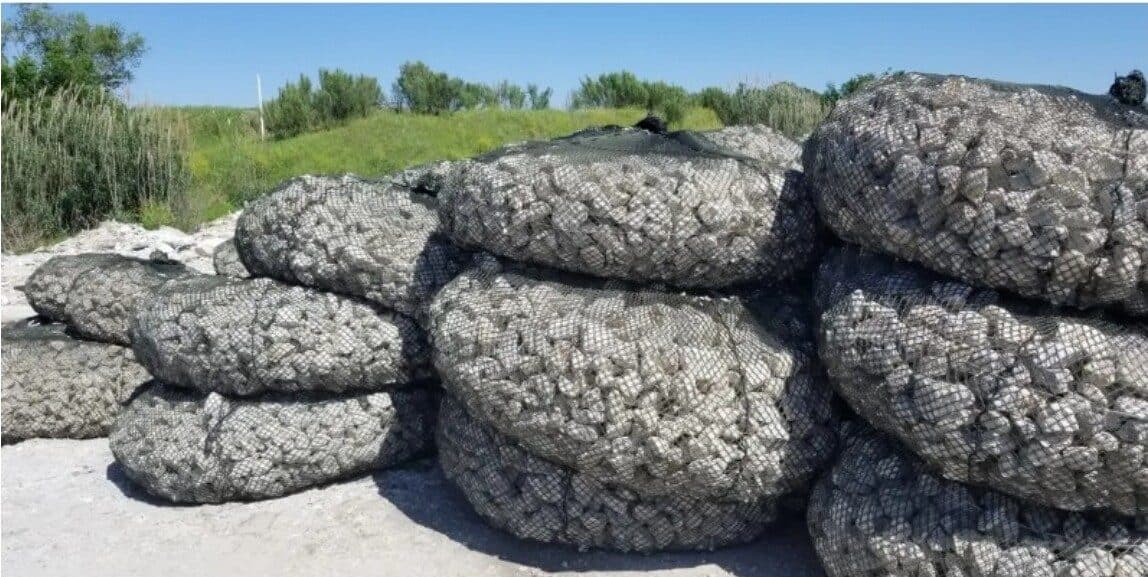
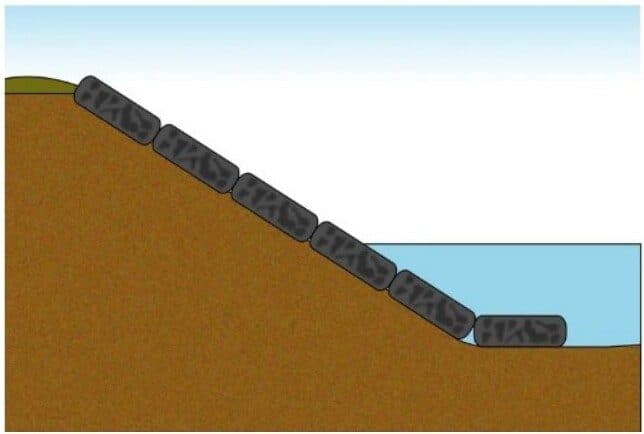
Rock bags are placed around piers and along abutments to armour the bed where scour starts. Each bag holds graded rock inside a flexible net, so it settles into the scour hole instead of rolling away like individual stones.
Why scour starts at a pier
Flow meeting a pier is pushed down its upstream face and rolls into a horseshoe vortex around the base. That vortex lifts bed material and carries it downstream, digging a hole that can reach well below the original bed. Abutments see the same effect where flow wraps around the embankment end.
On top of local scour, a bridge can see contraction scour (the whole channel bed lowering because the bridge narrows the flow) and long-term bed degradation. Protection has to allow for all three.
How rock bags are laid around a pier
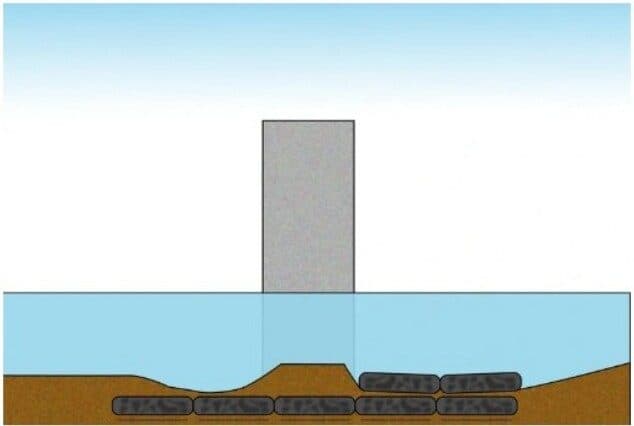
- Bags are placed in a ring or apron around the pier, extending out from the face so the vortex acts on armour rather than bed.
- Bags are set touching each other. Grouped bags interlock and resist higher currents than a single bag: for EVO Rock Bags, 4.7 to 5.9 m/s grouped against 3.2 to 4.0 m/s single.
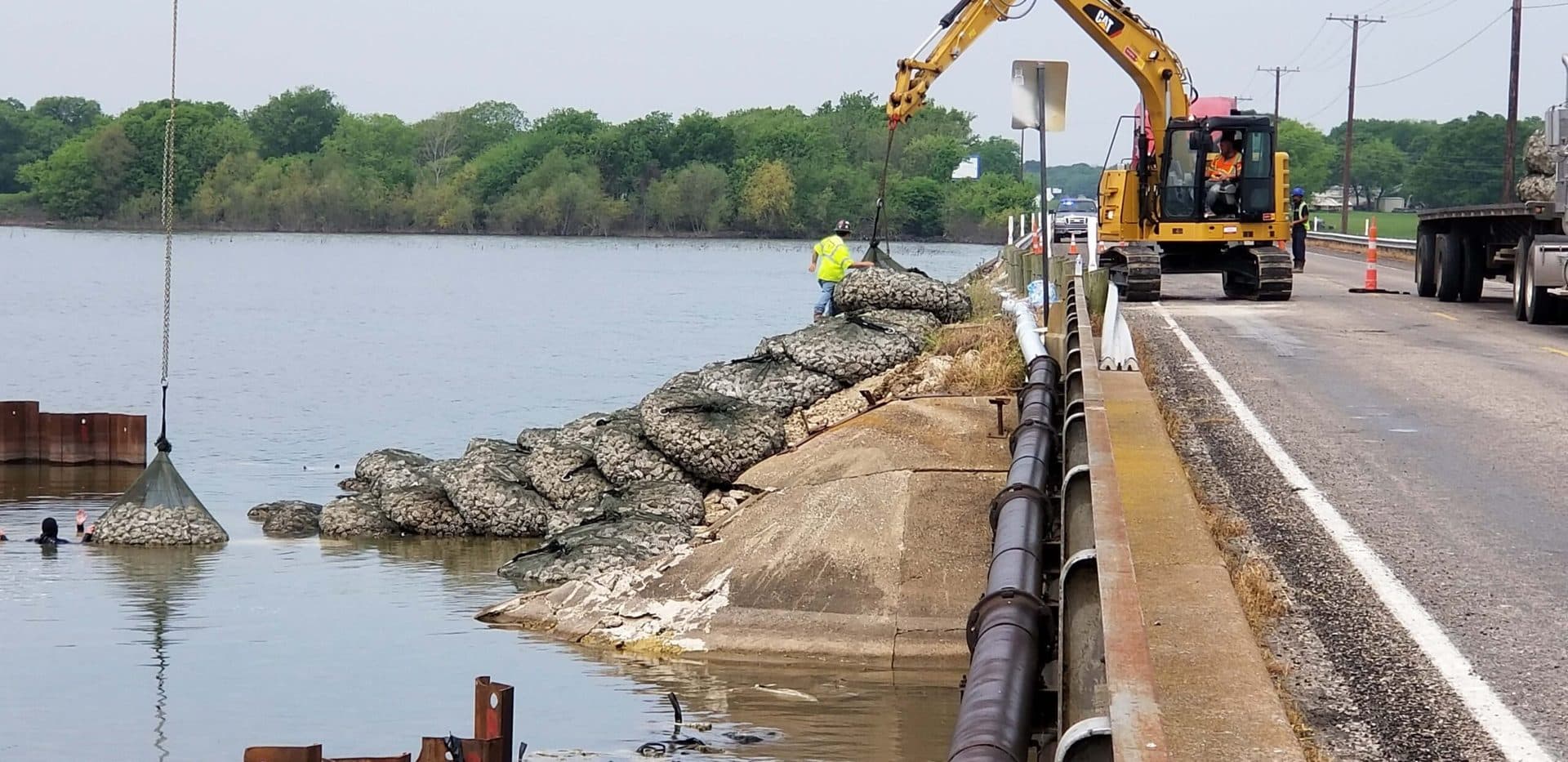
- Each bag is lifted by its ring with a crane or excavator and set in place, including underwater. No dewatering or cofferdam is needed in most cases.
- Because the net is flexible, a bag conforms to an existing scour hole or uneven bed. If the bed moves at the edge of the apron, the bags drape into it instead of leaving a gap.
- Where vegetation or a filter layer is part of the design, bags can be combined with it above water level.
Rock bags or loose riprap at a bridge
Loose riprap is the traditional countermeasure. It works, but each stone has to be heavy enough to stay put on its own, the layer needs a filter beneath it, and edge stones are the first to go. Placement underwater is hard to check.
A rock bag uses smaller rock, because the net holds it together as one unit of 2, 4 or 8 tons. Placement is one lift per bag, and the count is easy to verify. See the full rock bags vs riprap comparison.
What to send for a quote
- Pier and abutment layout, with dimensions
- Design flood velocity at the pier, or the hydraulic report
- Water depth and bed material
- Access for a crane or excavator, and whether the work is in the wet
- Whether the work is planned or an emergency repair after a flood
Questions
- Can rock bags be placed around a pier without dewatering?
- Yes. Each bag is lifted by a single ring and lowered into place by crane or excavator, so placement in flowing water is normal. Divers or survey are used to confirm the layout.
- Which rock bag size suits bridge scour?
- It depends on the design current at the pier. Compare the velocity with the ratings in the size guide; in grouped placement, the 2 ton bag is rated to 4.7 m/s, the 4 ton to 5.3 m/s and the 8 ton to 5.9 m/s.
- Can rock bags fill an existing scour hole?
- Yes. The flexible net lets the bag settle into the hole and take its shape, which is one of the main reasons they are used for repairs.
Published by EVOSNT Trading FZCO, manufacturer of EVO Rock Bags. Product figures are from our technical specifications. General guidance only; the project engineer is responsible for the final design.