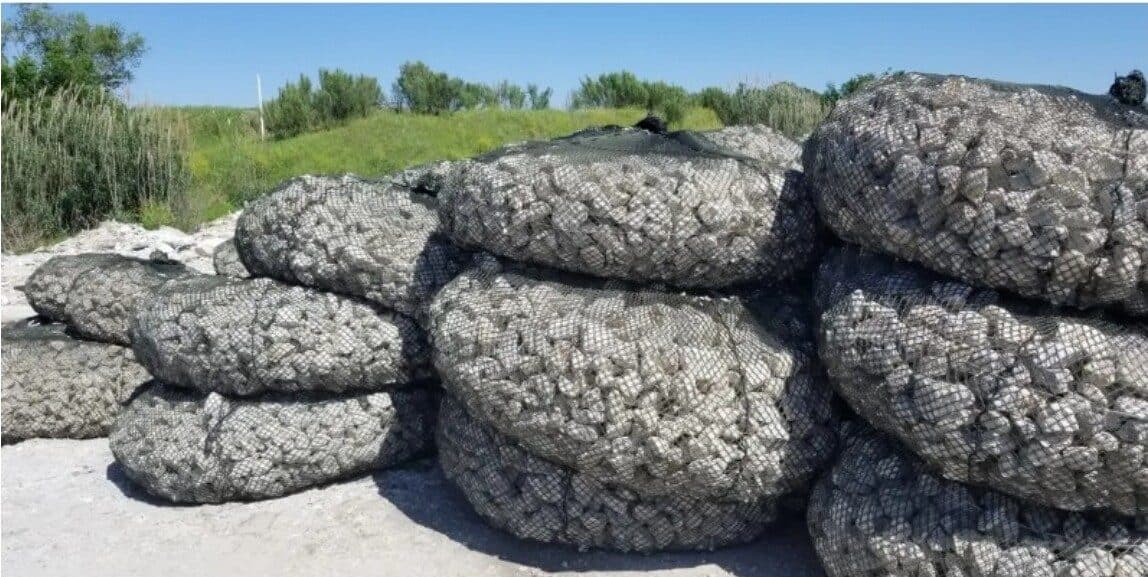
Riprap, a layer of loose rock, is the most common way to protect banks and beds from erosion. Rock bags hold smaller rock in a net, so each bag acts as a single unit of 2, 4 or 8 tons. The two do the same job in different ways.
Riprap is often the cheaper choice where large rock is close by and there is room to place it. Rock bags make sense where large rock is hard to get, where placement is underwater or tight, or where the edges of loose rock keep failing.
Side by side
| Rock bags | Loose riprap | |
|---|---|---|
| How it resists flow | The net holds rock together as one unit of 2 to 8 tons | Each stone must be heavy enough to resist the flow on its own |
| Rock size needed | 50 to 200 mm (75 to 200 mm for the 8 ton bag) | Grows with design velocity; large armour stone for fast flows |
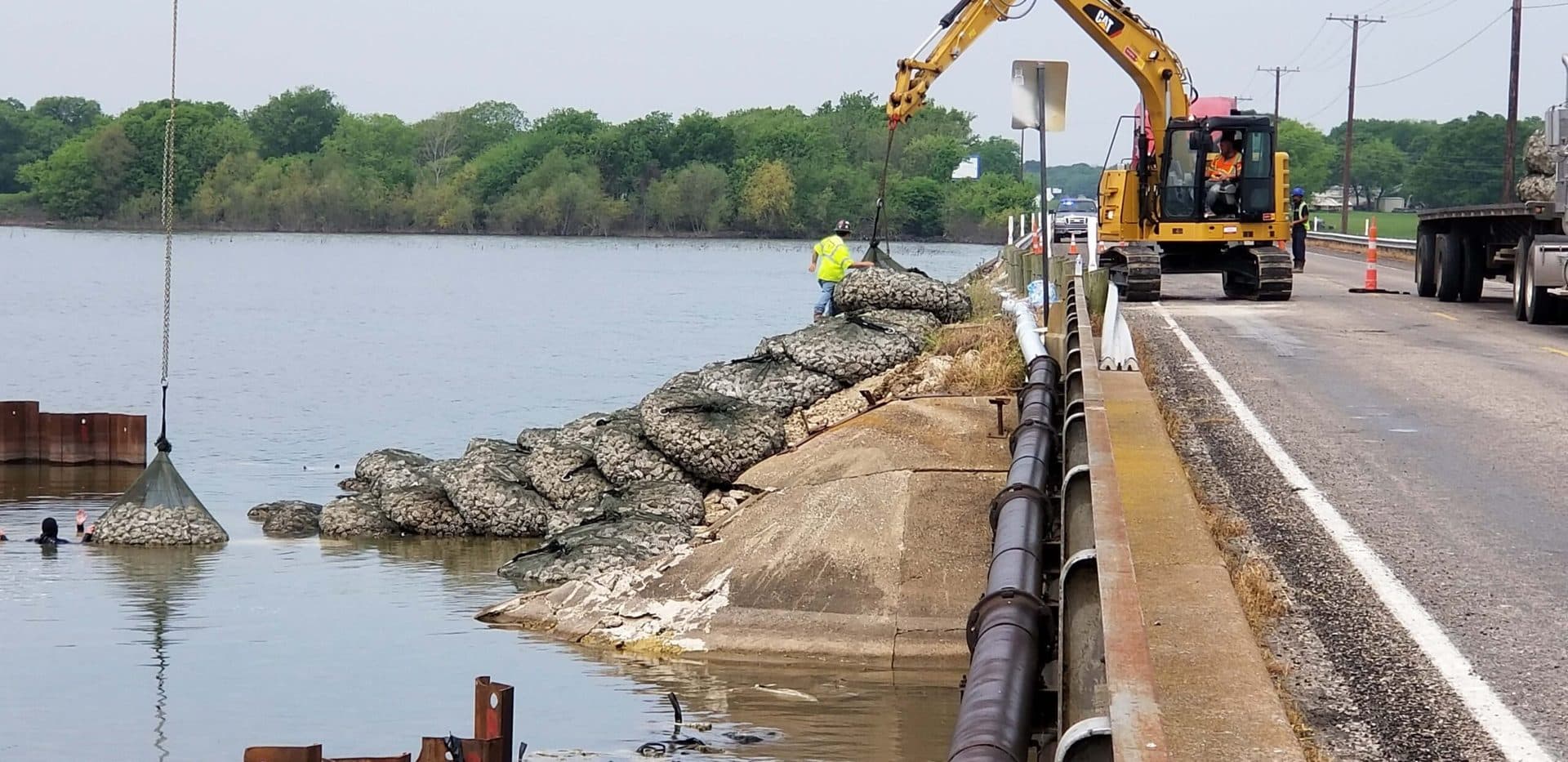
| Placement | One crane or excavator lift per bag, in the wet | Placed in bulk, then shaped; hard to check underwater |
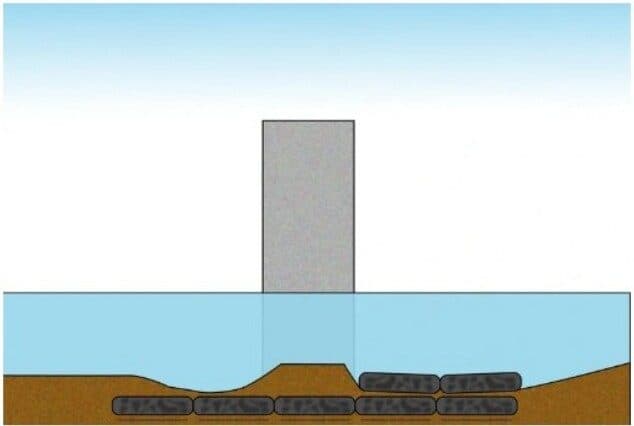
| Uneven or scoured bed | Bag conforms to the bed | Needs a prepared surface for a consistent layer |
| Edges and toe | Bags drape into scour at the edge | Edge stones are the first to move |
| Checking quantities | Count the bags | Survey layer thickness and extent |
| Material cost | Net plus smaller graded rock | Rock only, which is cheap if it is local |
When riprap is the better fit
- Large, durable rock is available close to site at low cost
- There is dry access and room to place and shape a layer
- Velocities are low enough for modest stone sizes
When rock bags are the better fit
- Only small rock or crushed concrete is available locally
- The work is underwater, in a fast current, or close to a structure
- An existing scour hole or uneven bed has to be covered
- The job is an emergency repair and has to be placed quickly
- Riprap has been placed before and keeps washing out at the edges
Using both
Rock bags and riprap are often combined: bags at the toe and around structures where scour is worst, loose rock on the rest of the slope. Check the bag size against your design velocity in the size guide.
Questions
- Are rock bags more expensive than riprap?
- Per tonne of rock, often yes, because of the net. The total cost can be lower where large rock would have to be imported, placement is underwater, or riprap would need repeated repairs.
- Can rock bags use smaller rock than riprap?
- Yes. EVO Rock Bags take 50 to 200 mm rock (75 to 200 mm for the 8 ton bag), because the net holds the stones together as one mass.
- Can crushed concrete be used in rock bags?
- Yes, rock bags can be filled with rock or crushed concrete, subject to the project specification.
Published by EVOSNT Trading FZCO, manufacturer of EVO Rock Bags. Product figures are from our technical specifications. General guidance only; the project engineer is responsible for the final design.