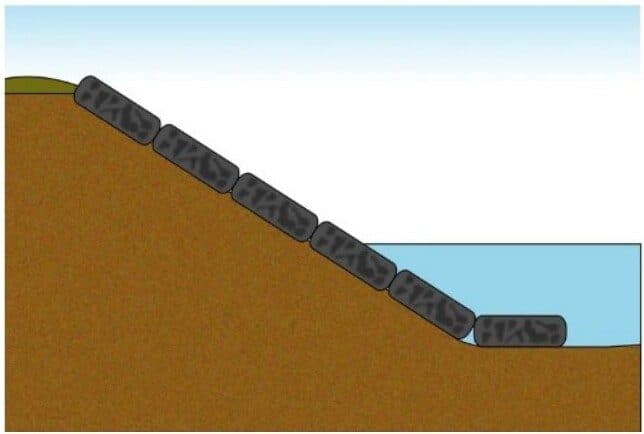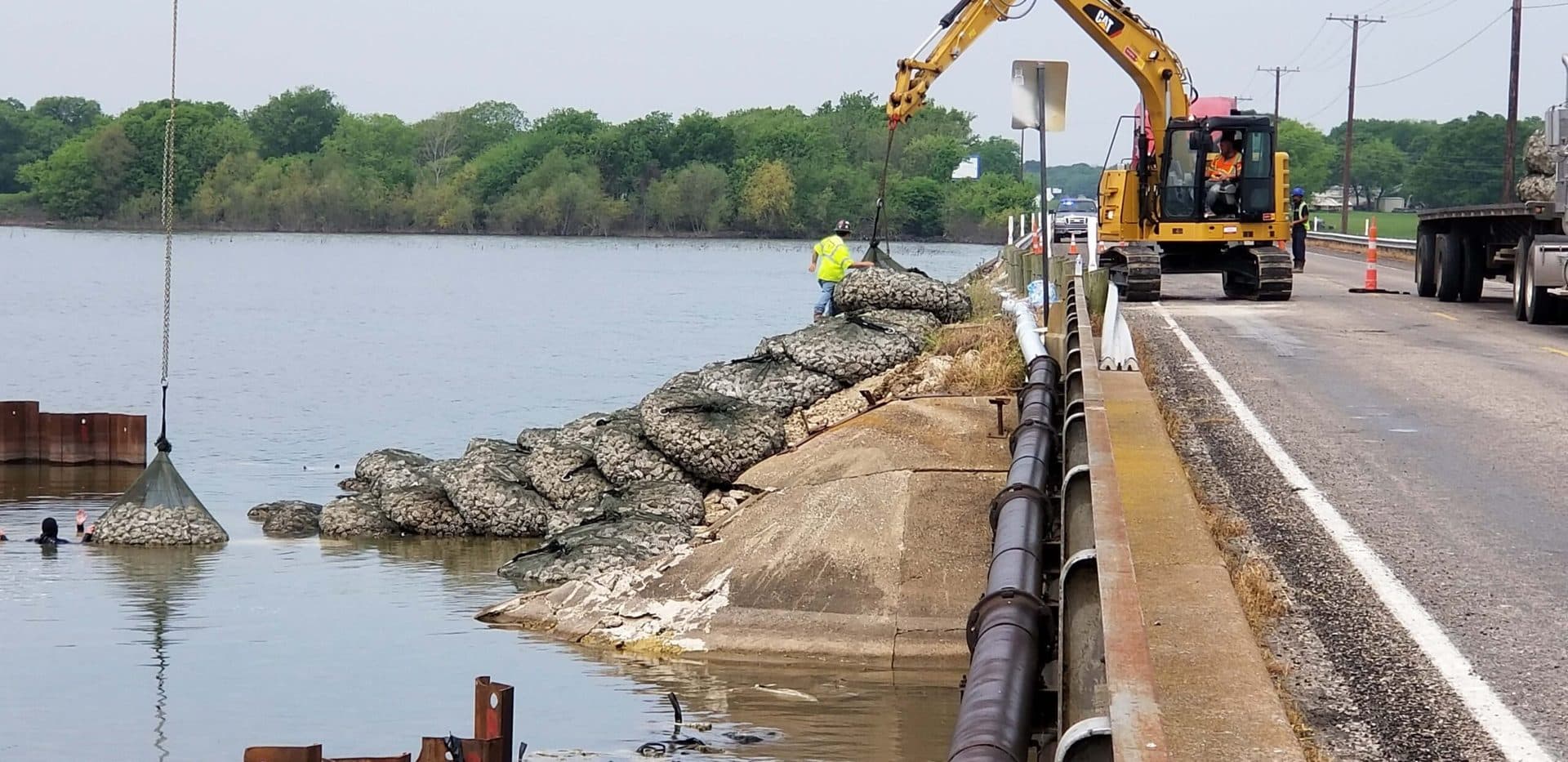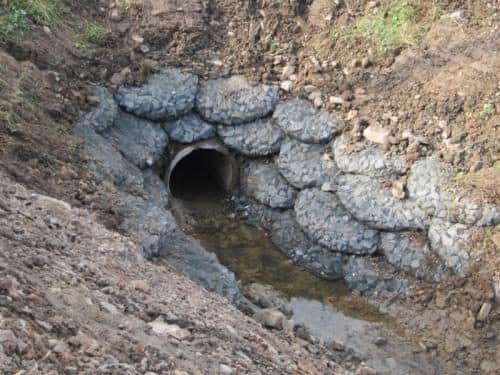

Gabions are wire mesh baskets filled with rock, usually on site, then laced together into walls or mattresses. Rock bags are nets filled with rock ahead of time and placed as single units.
Gabions are good at building vertical or stepped walls in the dry. Rock bags are better underwater, on uneven ground, and wherever the protection needs to move with the bed.
Side by side
| Rock bags | Gabions | |
|---|---|---|
| Container | Flexible polyester net | Steel wire mesh basket, galvanized or coated |
| Filling | Filled ahead of time on a frame, in a production setting | Usually filled in place, by hand or machine, then laced shut |
| Placement underwater | Normal: lifted and lowered by the ring | Difficult; baskets are usually built in the dry |
| Shape | Conforms to the bed and to scour holes | Holds a box shape; good for walls |
| Salt water and abrasion | No metal to corrode | Wire coating can be damaged by abrasion, then the wire corrodes |
| Vertical walls | Not intended as a wall | Well suited to retaining walls |
Where they work together
A common bank layout uses rock bags at the toe, below water, where scour is worst and gabions would be hard to build, and gabions higher up the bank where a stepped face is wanted. See riverbank erosion control.
When to choose rock bags
- Toe protection and bed protection below water
- Salt or brackish water, or abrasive bed load
- Scour holes and uneven surfaces
- Emergency works, where bags can be filled ahead and placed fast
Questions
- Do rock bags corrode like gabion wire?
- No. The net is polyester, so there is no steel wire to corrode in salt water.
- Can rock bags replace gabions in a retaining wall?
- Not usually. Gabions are better for vertical or stepped walls; rock bags are better as flexible toe, slope and bed protection.
- Are rock bags faster to install than gabions?
- Underwater and on uneven ground, generally yes, because each bag is pre-filled and placed in one lift.
Published by EVOSNT Trading FZCO, manufacturer of EVO Rock Bags. Product figures are from our technical specifications. General guidance only; the project engineer is responsible for the final design.