This is a starting clause for engineers writing a specification or bill of quantities that includes rock bags. Copy it, then fill in the bracketed items for your project.
Items in [square brackets] are design decisions for the project engineer. Figures for sizes, mesh and rock grading are EVO Rock Bag figures. Ask for our Technical specifications and Fill and Installation Manual to attach to the tender.
Specification clause
Clause text
ROCK BAGS FOR EROSION AND SCOUR PROTECTION

1. SCOPE
1.1 Supply, filling and placement of rock-filled net bags ("rock bags") for [erosion protection / scour protection / toe protection / bed protection] at the locations and to the extents shown on drawings [drawing numbers].

2. MATERIALS
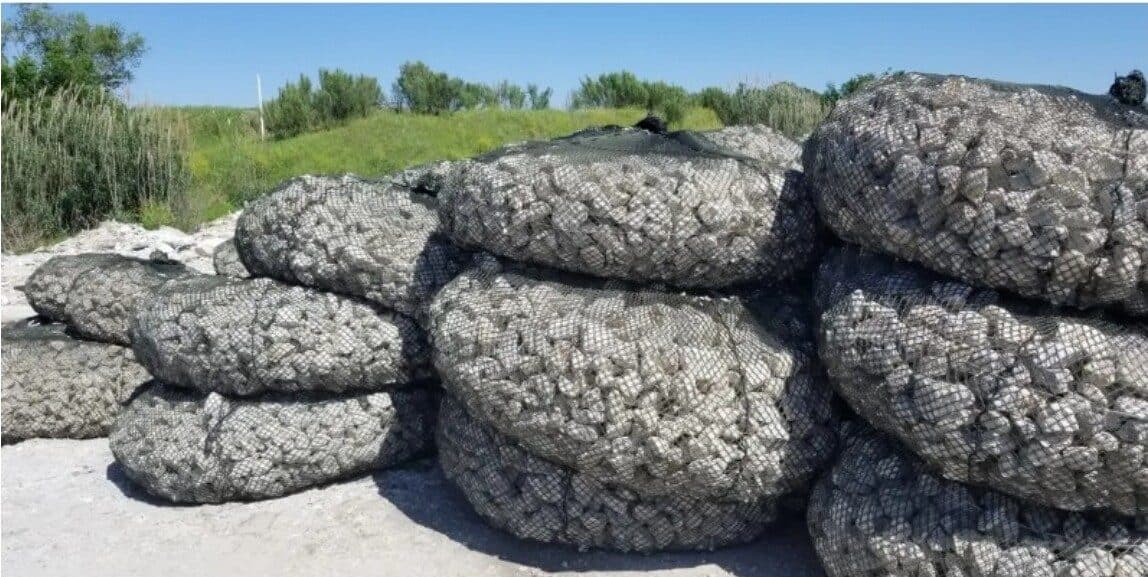
2.1 Net: knitted net of polyester yarn with UV and abrasion resistance, with a lifting ring forming the single lifting point. Mesh opening 25 mm for 2 ton and 4 ton bags, 50 mm for 8 ton bags.
2.2 The Contractor shall submit the manufacturer's technical data sheet and durability data for the net, for approval before supply.
2.3 Fill: clean, hard, durable rock or crushed concrete, free of clay, organic matter and friable material. Grading 50 to 200 mm for 2 ton and 4 ton bags, 75 to 200 mm for 8 ton bags. [Minimum particle density: ___ kg/m3.] [Source approval and testing requirements.]

3. ROCK BAG UNITS
3.1 Nominal size: [2 ton / 4 ton / 8 ton].
3.2 Filled unit to the manufacturer's dimensions for the nominal size (height, diameter and volume per the manufacturer's technical specification).
3.3 Units shall be rated by the manufacturer for a current velocity of not less than [design velocity] m/s in [single / grouped] placement.

4. FILLING
4.1 Bags shall be filled and closed in accordance with the manufacturer's Fill and Installation Manual, on a filling frame in a designated filling area.
4.2 Filled units shall be stored on level ground and handled only by the lifting ring.

5. PLACEMENT
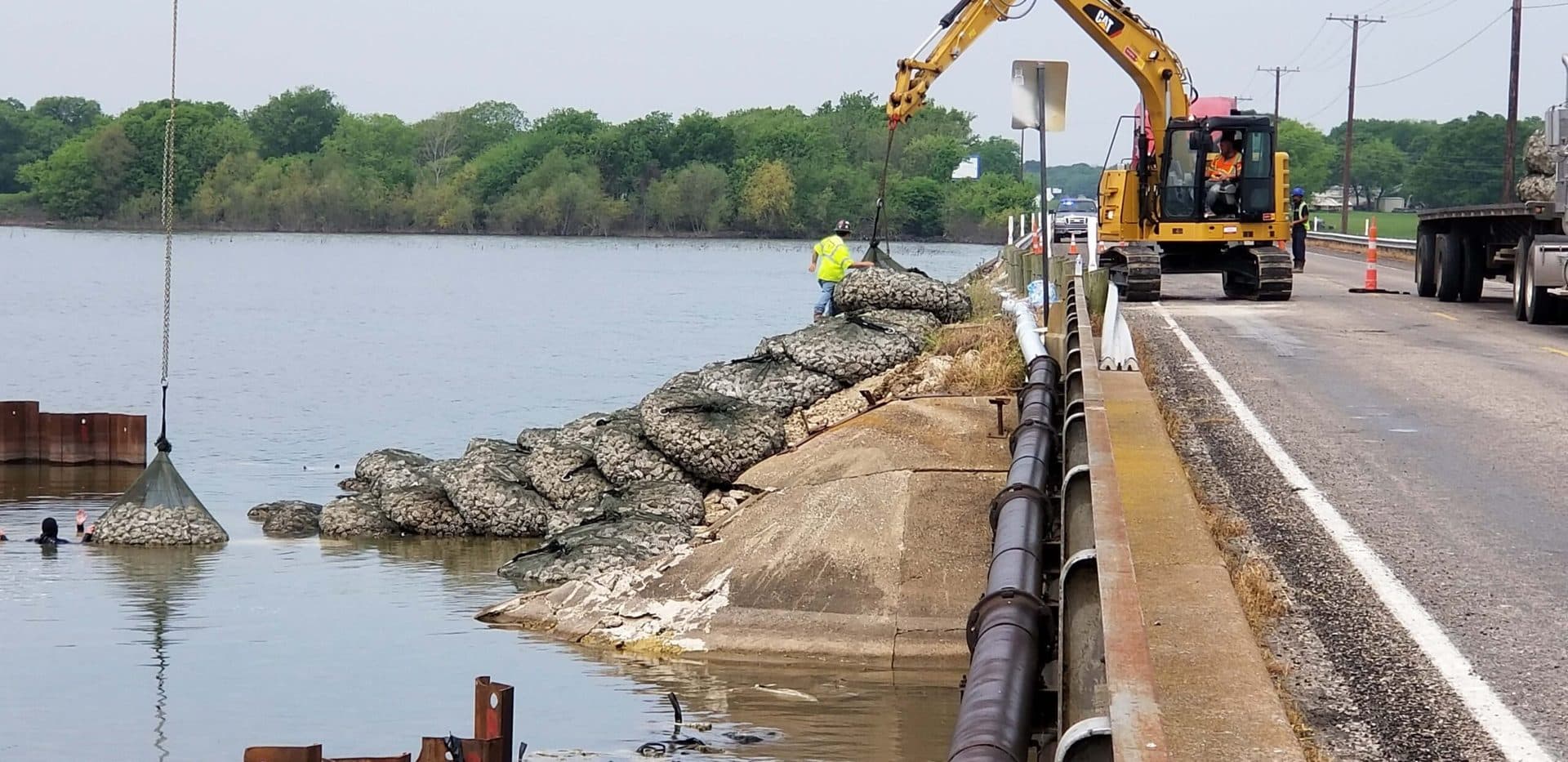
5.1 Units shall be lifted by the ring with a crane or excavator of adequate capacity and lowered to the bed. Units shall not be dropped [from a height greater than ___ m].
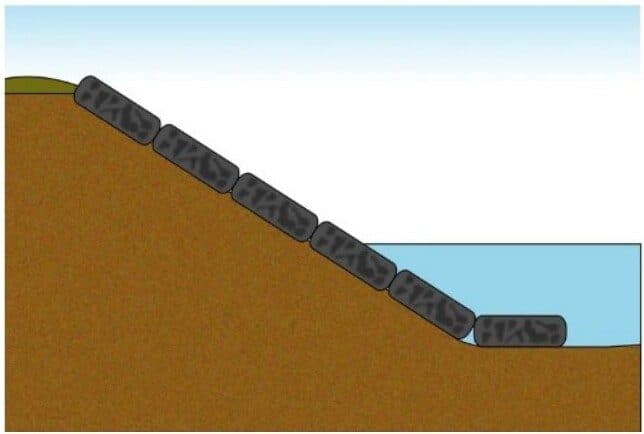
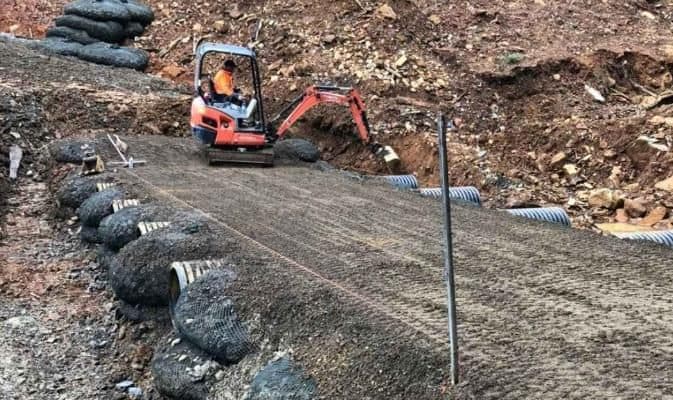
5.2 Units shall be placed in the pattern shown on drawings, [touching adjacent units / at ___ m spacing], starting from the [toe / downstream end].
5.3 [Filter layer / geotextile requirement beneath units, if any.]
5.4 Position of placed units shall be recorded by [survey / diver / ROV] and submitted as an as-built record.

6. SUBMITTALS
6.1 Manufacturer's technical specification and data sheet.
6.2 Manufacturer's Fill and Installation Manual.
6.3 Method statement for filling, handling and placement.
6.4 Fill material source and test results.
6.5 As-built record of units placed, with count and positions.

7. MEASUREMENT
7.1 Measured by number of units placed, by nominal size.
Notes for the designer
- Set the nominal size from the design velocity using the size guide. Ratings are for currents; check waves separately.
- Measure by number of units. It is simpler to check than volume or tonnage of loose rock.
- Decide on a filter layer from the bed material. The manufacturer's manual gives guidance; the design decision is the engineer's.
- Add any authority requirements for the site, such as environmental windows or working-in-water permits.
Get the documents for your tender
We send the Technical specifications, Fill and Installation Manual and Service Life & Durability Summary on request. Use the form on the rock bags page or the form below.
Questions
- Can I use this clause in a tender?
- Yes. It is a starting point: fill in the bracketed items and have the project engineer review it for the site.
- How should rock bags be measured for payment?
- By number of units placed, by nominal size. A bag count is easier to verify than a volume of loose rock.
- Where do I get the manufacturer's data sheet?
- Request the Technical specifications through the documents form on the rock bags page.
Published by EVOSNT Trading FZCO, manufacturer of EVO Rock Bags. Product figures are from our technical specifications. General guidance only; the project engineer is responsible for the final design.