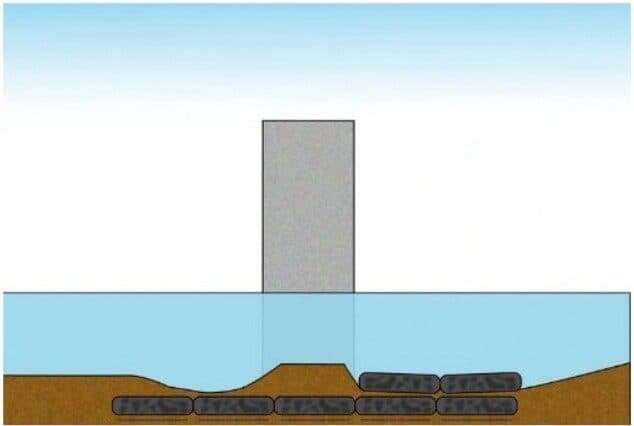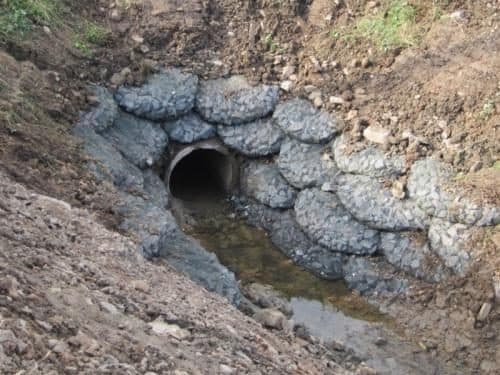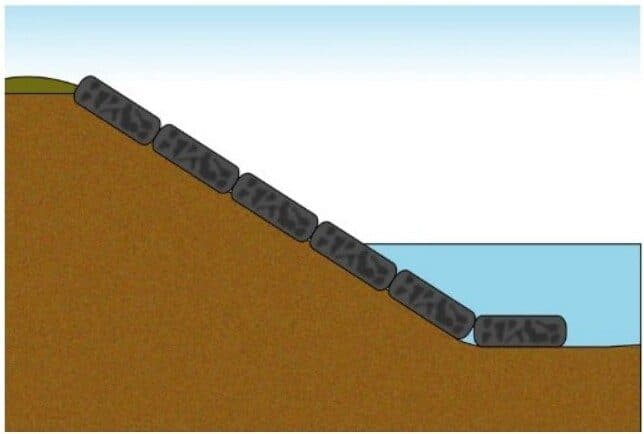
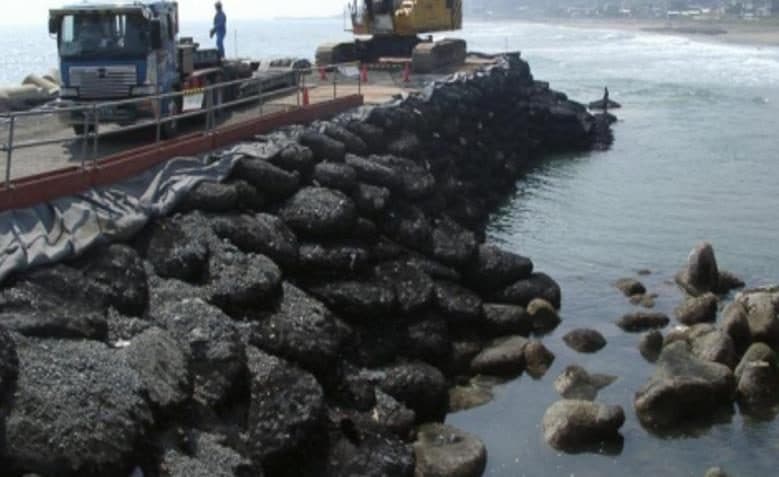
When a flood or a storm has undermined a bank, an outfall or a bridge foundation, the first job is to stop the damage getting worse before the next high water. Rock bags are used for this because each one is filled ahead of time and placed in a single lift, in the wet, usually without preparing the bed.
This page covers what to do first, what to survey and send, and how rock bags are used in a repair. It does not replace the assessment of the damaged structure by its engineer.
First, make the site safe
- Keep people and vehicles off a damaged bank, headwall or bridge until an engineer has looked at it. If a road or bridge is affected, its owner or the road authority decides on closure.
- Do not drive heavy plant onto an undermined bank or edge to place protection; the edge can give way under the load. Work from stable ground.
- Record what you see: photos from several angles with something for scale, the date, and the water level at the time.
What to survey
- The extent and depth of the scour hole or the lost bank
- Water depth and current at the damaged area, where they can be measured safely
- Whether foundations, piles, pipes or headwalls are exposed or undermined
- Access for a crane or excavator from stable ground, or from the water
Why pre-filled rock bags suit repairs
An emergency placement should be checked by the designer once the site is stable. It may become part of the permanent protection or need to be extended; that is the engineer's decision.
- Each bag is filled ahead of time and lifted by its single ring, so placement is one movement per bag.
- Bags are lowered by crane or excavator into flowing water; in most cases no dewatering or site preparation is needed.
- The flexible net lets a bag settle into an existing scour hole or onto an uneven bed and take its shape.
- Bags can be placed one at a time from stable ground, which keeps plant back from a weakened edge.
What to send us
Call +971 52 552 0113, or email photos to info@evosnt.com. The form below takes text only.
- Location and type of structure: bank, outfall, culvert, bridge, quay or coastal defence
- Photos of the damage, and the approximate length, width and depth of the area
- Water depth and current, if known
- Access for lifting plant
- Whether a structure is undermined, and who the asset owner is
Plan before the next event
If a site floods or erodes again and again, agree the bag size and a rough quantity with your designer before the next event, and decide where filled bags could be stored near the site. Then a repair is a matter of lifting and placing, not of design. Talk to us about it ahead of time.
To choose a size, see the size guide. For the structure types, see bridge pier scour, outfalls and culverts and riverbanks.
Questions
- Is an emergency repair with rock bags permanent?
- It can be, once the designer has checked the size, extent and layout. Treat the emergency placement as the start of the design, not a substitute for it.
- What size bag is used for an emergency repair?
- The same rule as for planned work: a size whose current rating is above the velocity at the damaged area. If the velocity is not known, send photos and the location and we will discuss the options.
- Who decides whether a damaged bridge or road stays open?
- Its owner or the road authority, on the advice of an engineer who has inspected it. Protection work comes after that decision.
Published by EVOSNT Trading FZCO, manufacturer of EVO Rock Bags. Product figures are from our technical specifications. General guidance only; the project engineer is responsible for the final design.