Rock bags are not the answer for every site. They are a poor fit where the flow is faster than the bags are rated for, where waves govern and nobody has checked stability, where large rock is cheap and easy to place, and where the job needs a wall or a structure that carries load.
We would rather you use the right system than the wrong bag. Each case below says what usually works better, drawn from our comparisons with riprap, gabions, concrete mattresses and sand containers.
Currents faster than the ratings
EVO Rock Bags are rated for currents up to 4.0 m/s placed singly and 5.9 m/s placed as a group (8 ton bag). Those are the velocities at which the bags show no movement. Above them, a single layer of bags is the wrong design.
A site with a higher design velocity may still use rock bags in several layers or as part of a combined system, but only where the project engineer has designed and checked that arrangement. Without that, look at systems designed for the velocity.
Waves govern and stability has not been checked
Our published ratings are for currents only. On an exposed coast, at a breakwater or in the breaking zone, wave height and period decide whether a unit stays put. If no one has checked the bags against the site's wave conditions, do not rely on them there.
Send the wave climate and we will advise, or ask your coastal engineer for armour sized for the waves.
Large rock is cheap, close by and easy to place
Riprap is often the cheaper choice where large, durable rock is available near the site, there is dry access, and there is room to place and shape a layer. The bag adds cost that this kind of site does not need.
Rock bags still earn their place on the same job at the toe, around structures and in scour holes. See rock bags vs riprap.
The job needs a wall or carries load
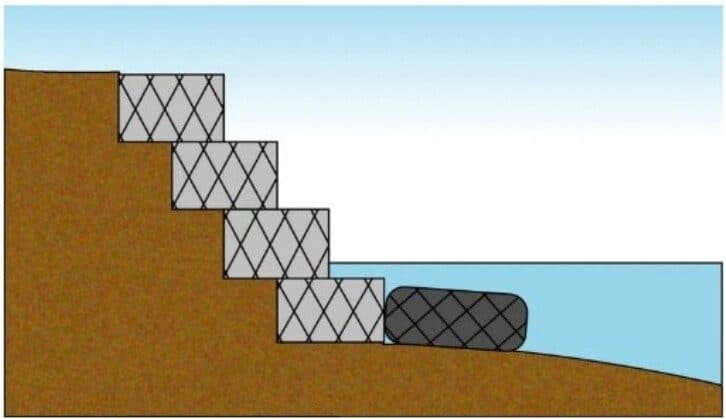
Rock bags are flexible protection for toes, slopes and beds. They are not intended as a retaining wall, and they are not a foundation or a structural element. For a vertical or stepped wall, gabions or a designed retaining structure are the usual choice. See rock bags vs gabions.
Long, even runs that need a set cover thickness
Where a long length of pipeline or cable needs a defined, even cover, or the asset owner calls for a mattress system, articulated concrete mattresses are often the better fit. Rock bags are then used at the ends and edges, where scour develops. See rock bags vs concrete mattresses.
Low-energy, temporary works with sand on site
If rock is unavailable or costly, sand is on site, currents are low and the protection is temporary or will be buried, geotextile sand containers can be the cheaper option. See rock bags vs geotextile sand containers.
In short
| Situation | What usually works better |
|---|---|
| Design velocity above the grouped rating, with no layered or combined design | A system designed for that velocity, or a layered design checked by the engineer |
| Waves govern and stability has not been checked | Armour sized for the wave climate by a coastal engineer |
| Large rock is cheap and close, with dry access and room to work | Loose riprap, with bags only where scour is worst |
| A vertical or stepped wall, or a load-bearing element | Gabions or a designed retaining structure |
| Long, even pipeline or cable runs needing a set cover | Concrete mattresses, with bags at the ends |
| Low-energy, temporary works with sand on site | Geotextile sand containers |
Questions
- What are the main disadvantages of rock bags?
- Their published ratings cover currents, not waves; they are not a wall or a structural element; and where large rock is cheap and placement is in the dry, loose riprap is often cheaper.
- Can rock bags be used where the current is faster than 5.9 m/s?
- Not as a single layer, based on the published ratings. Several layers or a combined system may work, but only as a design the project engineer has checked. Send the site conditions and we will advise.
- Are rock bags worth it for temporary works?
- Sometimes, for example in an emergency repair. On low-energy temporary works with sand on site, geotextile sand containers are often cheaper.
Published by EVOSNT Trading FZCO, manufacturer of EVO Rock Bags. Product figures are from our technical specifications. General guidance only; the project engineer is responsible for the final design.