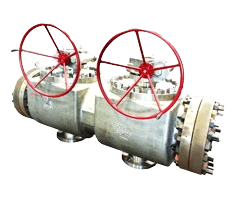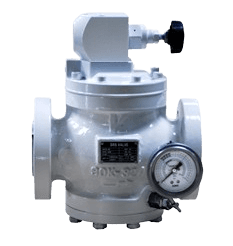
A cryogenic valve is a valve built to work and seal at very low temperatures, usually in liquefied gas service. Liquefied natural gas (LNG), for example, is natural gas cooled to a liquid at about −260 °F, roughly −162 °C, according to the US Department of Energy. The international standards for isolating valves in low-temperature service, ISO 28921-1 and ISO 28921-2, cover design temperatures down to −196 °C.
Three things set a cryogenic valve apart from a standard one: an extended bonnet, materials that stay tough in the cold, and testing at low temperature.
Why the bonnet is extended
The stem seal (the packing) has to stay warm enough to seal and to let the stem turn. An extended bonnet puts distance between the cold fluid in the body and the packing at the top.
Liquid that rises into the extension boils off, and the column of gas that forms there insulates the packing from the cold. That is why many cryogenic valves must be installed with the stem upright or within an angle the supplier states: tilted too far, liquid can reach the packing.
Materials that stay tough in the cold
Many steels lose their toughness and become brittle at very low temperatures. Bodies, bonnets and trim for cryogenic service are made from materials that stay tough in the cold, such as austenitic stainless steels, and specifications often call for impact testing at low temperature. Seats and seals are chosen for both the temperature and the fluid.
Testing at low temperature
A valve that seals at room temperature may not seal when its parts have shrunk in the cold, so cryogenic valves are tested cold as well. ISO 28921-1 covers design, manufacturing and production testing of low-temperature isolating valves, and ISO 28921-2 covers type testing. BS 6364, an older British specification, is listed by BSI as withdrawn. See cryogenic valve testing standards.
Other design points
- Cavity relief. Liquid trapped in the body of a closed ball or gate valve expands as it warms. Cryogenic designs give it a relief path, which often makes the valve seal in one direction only.
- Shrinkage. Body, trim and seals contract by different amounts as they cool. The design has to keep the valve sealing and operable through that change.
- Cleanliness. Equipment for oxygen service is cleaned before use, because contaminants such as oils and greases can cause combustion in an oxygen atmosphere (AIGA 012/19). State oxygen service in the RFQ.
Where cryogenic valves are used
Ball, gate, globe, check and butterfly valves are all built for cryogenic service, as well as safety relief valves and control valves. See the cryogenic valves in our range.
- LNG liquefaction, storage, regasification, bunkering and LNG carriers
- Air separation plants producing liquid nitrogen, oxygen and argon
- Liquid hydrogen systems
- Industrial gas storage and transfer
Questions
- What temperature counts as cryogenic?
- There is no single cut-off in everyday use. The ISO 28921 standards for low-temperature isolating valves cover design temperatures from −50 °C down to −196 °C, and LNG is at about −162 °C.
- Why must some cryogenic valves be installed upright?
- The extended bonnet relies on a column of gas to keep the stem packing warm. Tilted too far from upright, liquid can reach the packing. The supplier states the allowed angle.
- Is an extended bonnet valve the same as a cryogenic valve?
- The extended bonnet is one feature of a cryogenic valve. The materials and the low-temperature testing matter just as much.
Sources
- US Department of Energy, Liquefied Natural Gas (LNG)
- EVS-EN ISO 28921-1:2022, Estonian Centre for Standardisation (scope of ISO 28921-1:2022)
- ISO 28921-2:2015, Swedish Institute for Standards (scope)
- BS 6364:1984, BSI Knowledge (status: withdrawn)
- Asia Industrial Gases Association, AIGA 012/19 Cleaning of Equipment for Oxygen Service
Published by EVOSNT Trading FZCO (EVO LNG Supply). General guidance for engineers and buyers; the purchaser's specification and the applicable standards govern the design and testing of any valve. See our valve range.